

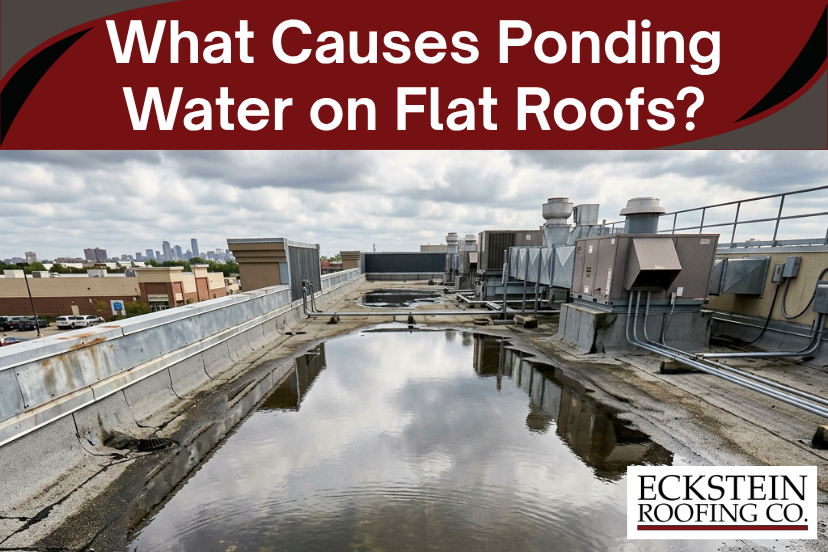
Flat roofs are built to move water, not hold it. When water stays on the surface for more than 48 hours after rainfall, that is ponding water, and it signals a drainage or structural issue that will not resolve on its own.
At Eckstein Roofing, we have been solving flat roof drainage problems since 1945. As a third generation family owned contractor with more than 80 years of continuous field experience, we do not treat ponding water as a surface defect. We treat it as a system failure that has a specific cause and a measurable solution.
This page is designed to help you understand the real causes of ponding water on flat roofs, how serious the issue is, and when to take action before repair costs escalate.
If You Are Seeing Ponding Water, Here Is What It Means
If water is still sitting on your roof 48 hours after rain, your roof is not draining correctly.
According to the National Roofing Contractors Association, this condition is a recognized performance failure threshold . Even more concerning is the weight. One inch of water adds approximately 5.2 pounds per square foot of load. On a commercial roof, that becomes thousands of pounds of unnecessary structural stress.
This is not cosmetic. It is mechanical stress on your building.
The Real Causes of Ponding Water on Flat Roofs
Most roofers will give you a simple answer. In reality, we rarely find just one cause. Ponding water is almost always a combination of design, installation, and aging factors. Below are the actual causes of ponding water we see in the field.
The Roof Was Never Built with Enough Slope
Flat roofs must be sloped. Building guidance commonly requires a minimum slope of 1/4 inch per foot. When slope is too low or inconsistent, water slows down and stops moving. Over time, even small depressions become permanent collection zones.
This is one of the most common and most expensive causes because it cannot be corrected with patchwork repairs.
What this looks like in real buildings
- Water that always returns to the same low spots
- Visible “birdbath” areas after every storm
- Roof areas that never fully dry
If this is happening, you are already dealing with a system level drainage failure.
2. Drainage Design Does Not Match Roof Layout
Even a properly sloped roof will fail if drains are poorly placed.
We often find:
• Drains positioned away from low points
• Insufficient number of drains for roof size
• Scuppers too small for rainfall volume
• Retrofit systems using outdated drainage locations
High performance systems from Duro-Last® Roofing are engineered to improve water management, but they still depend on correct installation design. When drainage layout is wrong, ponding water becomes unavoidable.
3. Drains Are Blocked or Not Functioning
This is the simplest cause, but also one of the most damaging when ignored.
We routinely find drains reduced to a fraction of their capacity due to:
- Leaves and debris
- Membrane buildup
- Ice formation
- Lack of seasonal maintenance
When water cannot exit the roof, it spreads and collects. This is why maintenance is not optional for flat roofs. It is part of the system design.
4. Structural Deflection Is Creating Low Spots
Buildings move over time. Steel flexes. Wood sags. Concrete settles.
When that happens, new low points form where water collects. This is one of the most overlooked causes of ponding water on flat roofs because it develops slowly. Many property owners do not notice it until ponding becomes widespread.
After 80 plus years since 1945, we consistently see structural deflection as a major factor in older buildings and buildings that have been modified over time.
5. Insulation Has Shifted or Been Installed Incorrectly
Modern flat roofing systems rely on insulation to create slope direction.
Problems occur when:
- Insulation compresses under foot traffic
- Tapered systems are installed incorrectly
- Drain-directed slope is inconsistent
- Insulation thickness is inadequate near drains
The result is subtle depressions that trap water even when the roof looks level. This is a technical issue that requires technical correction.
6. The Roof System Has Reached End of Service Life
All roofing systems age. As membranes expand and contract through seasonal cycles, seams, adhesives, and substrate layers begin to shift. Drainage performance slowly declines. At this stage, ponding water is usually a symptom that the system is no longer performing as designed.
Why We Are Called First for Complex Flat Roof Issues
Our work is not about volume. It is about diagnosing roofing issues correctly and delivering long term solutions that last. We have been family owned and operated since 1945, and our work spans residential, commercial, specialty metal, and tile roofing systems. That range matters because ponding water rarely comes from a single failure point.
Our process is built to identify the root cause, not guess.
Our field evaluation includes:
- Laser slope mapping across the entire roof
- Drain flow and capacity testing
- Core sampling of insulation systems
- Moisture scanning for hidden saturation
- Structural movement assessment
We do not recommend solutions until we know exactly why the ponding water is happening.
Commercial Flat Roof Systems: Duro-Last
For commercial and low slope roofs, we install engineered PVC systems from Duro-Last Roofing. These are not traditional field built roofing systems. They are factory fabricated membrane systems designed to reduce installation error and improve long term waterproof performance.
What makes this system different
According to the manufacturer, a large portion of seams are prefabricated in a controlled environment before the material ever reaches the job site. That matters because seams are one of the most common failure points in flat roofing systems.
Why this helps with ponding water issues
When water sits on a roof, it puts constant pressure on:
- Seams
- Drain transitions
- Penetration points
Factory fabricated systems reduce the number of field seams and potential weak points, which helps improve performance in areas where water drainage is slow or temporarily delayed.
Bottom line for property owners
If your roof has standing water, you do not just need a patch. You need a system designed to handle long term water exposure. If you are seeing ponding water on a commercial roof, schedule an inspection with us before the issue spreads.
The Real Problem Is Not the Material. It Is the System.
Most roofing problems we inspect are not caused by bad shingles or bad membranes.
They are caused by:
- Incorrect drainage design
- Improper slope
- Wrong system selection for the roof type
- Aging or stressed structural conditions
This is why ponding water shows up even on “high quality” roofs. It is not about what was installed. It is about whether it was installed as a complete system designed for how your roof actually drains.
STOP WAITING: Ponding Water Gets More Expensive Over Time
If water is sitting on your roof after every rain event, the damage is already in progress.
- Every storm increases:
- Structural load
- Membrane fatigue
- Insulation saturation
- Leak probability
This is where small drainage issues turn into full roof replacements.
Get a Professional Flat Roof Assessment Before Damage Spreads
We provide direct, on site flat roof evaluations that identify the actual causes of ponding water and outline correction options based on real conditions, not assumptions. You do not need to wait for interior leaks to take action.
Schedule Your Roof Inspection
If your roof is holding water, do not wait for leaks to appear inside your home or building. Contact us today to schedule a professional inspection and get a clear diagnosis before damage spreads.
Frequently Asked Questions
What is ponding water on a flat roof
Water that remains on a roof surface for more than 48 hours after rainfall.
What are the main causes of ponding water on flat roofs
Poor slope design, drainage layout issues, clogged drains, structural deflection, insulation problems, and aging roofing systems.
Is ponding water dangerous
Yes. It increases structural load and accelerates roof system failure.
Can ponding water be fixed without replacing the roof
In some cases yes, depending on severity. Solutions may include drainage correction or insulation rework.
How quickly should ponding water be addressed
Immediately. The longer it remains, the higher the risk of structural and interior damage.