


Clay roof tiles are shaped from natural clay and fired in a kiln. Concrete roof tiles are made from cementitious materials, sand and aggregates, then cured. Both can create attractive, long-lasting roofing systems, but their weight, surface finish, moisture behavior and installation details depend on the exact product. For a Greater Cincinnati home, the better choice is the one that fits the structure, roof design, weather exposure and appearance you want, not simply the material with the better reputation.
A curved Spanish-style roof may catch your eye first. Before choosing that look, though, you need to know what the tiles are made of, what the entire roof will weigh and how its water-shedding layers will be built.
What Actually Makes Clay and Concrete Tiles Different?
Clay tiles begin with natural clay or similar earthen material, shaped and fired at high temperatures. Concrete tiles use cement-based binders and aggregates that are formed and cured. The Tile Roofing Industry Alliance installation manual describes both manufacturing categories and explains why product design, dimensions and exposure affect installed performance.
Those different manufacturing processes influence the finished tile, but they do not produce one uniform clay product or one uniform concrete product. A dense fired clay tile, a textured clay tile, a coated concrete tile and a through-colored concrete tile may look and weather differently. Ask for the data sheet of the exact tile rather than relying on broad claims about the material.
 Does Clay Tile Weigh Less Than Concrete Tile?
 Does Clay Tile Weigh Less Than Concrete Tile?
Some clay tile products are lighter than some concrete alternatives, which can matter when your roof structure has limited capacity. But there is no dependable rule that every clay tile is lighter. Thickness, shape, size, headlap, fastening and the number of pieces required per roof area all change the installed weight.
Compare the manufacturer’s weight per roofing square, which is 100 square feet of roof area, for the specific products under consideration. Then include underlayment, battens where specified, attachments, ridge and hip pieces, and other system materials. The industry installation guidance specifically directs designers to account for these additional components, not just the individual tile.
For a new custom home, the builder and structural designer can plan for the chosen roof assembly early. For an existing home being converted from a lighter covering, the framing, decking, connections and existing condition need to be evaluated before ordering tile. An engineer may need to determine whether reinforcement is required; tile selection should not become a structural guess.
If you own an older home, evaluating its existing roof structure is especially important before choosing a tile roofing system. We explore these considerations further in our article on specialized roofing challenges for older Cincinnati homes. Here, the immediate goal is narrower: confirm the load the proposed tile system will place on your particular roof.
Moisture Absorption and Cincinnati Freeze-Thaw Weather
Greater Cincinnati roofs experience rain, cold weather and repeated periods when moisture can freeze and thaw. Water absorbed into a porous material can create stress as it freezes, so freeze-thaw resistance deserves attention when choosing either type of tile. Concrete tiles can absorb moisture, but that does not mean every concrete tile will crack in winter. Clay tile can absorb moisture and can also suffer weather damage if the product or installation is unsuitable.
The Tile Roofing Industry Alliance installation manual references ASTM C1492 for concrete tile and ASTM C1167 for clay tile in regions where freezing and thawing are concerns. These standards help evaluate how the materials perform under those conditions, but they do not guarantee that a roof will never experience damage. Before selecting either material, we recommend reviewing the manufacturer’s product testing information and confirming that the tile and complete roofing system are suitable for Greater Cincinnati’s climate.
Roof design also affects how much moisture remains around the tiles. Appropriate slope, drainage, underlayment, flashing and attachment details help the complete system manage rain and melting snow. Even a tile with suitable freeze-thaw performance cannot compensate for a poorly planned water-management system.
Tile Material Is Not the Same as Tile Shape
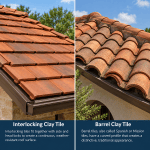
A common point of confusion is the language used to describe the roof’s appearance. Clay and concrete describe what the tile is made from. Barrel, Spanish, S-profile, flat and interlocking describe shapes or ways tiles fit together. A Spanish-looking roof is not automatically clay, and a curved tile is not automatically a traditional two-piece barrel system.
Interlocking tiles have formed edges that fit with adjacent pieces, while traditional barrel or mission arrangements use curved pieces to create a pronounced repeating pattern. The roof’s pitch, hips, ridges, penetrations and transitions affect which profiles can be installed and how much cutting and detailing will be involved. Our clay tile work frequently involves interlocking and barrel configurations, including Spanish or S-profile appearances where the selected system calls for them.
Color is another design choice that should be evaluated product by product. Fired-clay finishes, glazes, surface textures and concrete color treatments may change the look of a roof as it weathers. Review actual samples in daylight and ask what the manufacturer says about the specific finish rather than expecting a brochure photograph to predict decades of exposure.
For example, Ludowici provides technical information for its Classic 14-inch interlocking clay tile, while its broader technical library contains separate documentation for other profiles. That is a useful reminder that even tiles from the same manufacturer can have different specifications and installation requirements.
The Roof System Beneath the Tile Matters Just as Much
Tile is the visible weathering surface, not the entire roof. The underlayment provides an important secondary water-resistive layer, while flashings manage transitions at chimneys, walls and other openings. Fasteners or approved attachment methods must suit the tile, deck, wind requirements and manufacturer’s system details.
Roof slope affects how a tile system sheds water and which additional measures may be required. A complicated roof with dormers, short slopes, hips and multiple transitions can demand more custom fitting than a simple gable roof. The Tile Roofing Industry Alliance installation guides address system-level installation considerations, including cold-weather applications, but the selected manufacturer’s instructions and applicable code still govern the project.
A product may have the color and shape you want but still be unsuitable for the roof pitch, structural capacity or planned attachment method. That is why the useful question is not just “Which tile do I like?” It is “Can this complete tile assembly be installed correctly on my house?”
How Do Clay and Concrete Tile Age?
Both materials can provide durable roofing when their products are suited to the location and properly installed. Their appearance may change differently as surfaces weather, finishes wear or deposits accumulate. Color retention depends on the tile body and finish, so compare the manufacturer’s actual documentation instead of accepting blanket promises about fading.
Individual tiles may chip or break from impact or foot traffic. That is different from a problem in the underlayment or flashing below, which can affect water protection even when most visible tiles remain intact. Periodic observations and careful maintenance should address both the exposed tile and the hidden parts of the assembly.
If a tile is broken, replacement may be appropriate when compatible pieces are available and the rest of the system is serviceable. Our residential roof repair services address targeted roofing problems, but the larger material-selection decision should be made before installation, not after a mismatch becomes apparent.
Price is best compared using actual proposals for complete, equivalent systems. Material availability, specialty trim pieces, roof complexity, access, labor and any structural changes can matter as much as the field tile price. An unsupported “clay always costs more” or “concrete always costs less” statement will not help you budget accurately.
A Practical Checklist Before Choosing Tile
Start with the architectural result you want: a rounded barrel pattern, a flatter interlocking appearance or another profile. Then narrow the options to products with published specifications suitable for your roof. The comparison should cover installed weight, framing capacity, approved slope, freeze-thaw performance, attachment method, color and finish, accessory availability, and maintenance expectations.
For an existing home, establish the condition and capacity of the structure before treating either material as a final selection. For a new build, coordinate the product choice with the architect and structural designer while roof framing and details can still be planned around it. Ask your contractor to explain the complete assembly rather than showing only a tile sample.
Why Our Clay Tile Experience Matters
We have installed clay tile roofing in Greater Cincinnati since Eckstein Roofing was founded in 1945. Today, we use Ludowici almost exclusively for our clay tile projects, and we are a Ludowici Certified Installer authorized to purchase and install its clay tile products. We have installed concrete tile in the past, but it has not been a regular part of our work for many years.
That experience is especially useful when a clay tile roof requires careful profile layout, underlayment coordination, fastening, flashing and detailed work around roof transitions. Our residential roofing services include specialty steep-slope systems, and we can discuss whether a particular clay tile design is appropriate for your home rather than assuming that every attractive tile belongs on every roof.
Planning a custom home, renovation or tile roof replacement in Greater Cincinnati? Contact us for a residential roofing estimate and a conversation about the tile profile, roof conditions and system details that need to be settled before installation.
HELP ME WITH MY ROOFING PROJECT
Frequently Asked Questions
Can a concrete tile roof be replaced with clay tile?
Potentially, but the replacement is not necessarily a direct swap. Compare the new product’s weight, dimensions, attachment, slope requirements and accessory details, and evaluate the existing structure and underlayment before choosing the assembly.
Does a tile roof require special walking precautions?
Yes. Individual tiles can crack under concentrated foot traffic, and the appropriate access method depends on the profile and roof conditions. Keep routine roof access to qualified professionals familiar with the system.
Can clay and concrete tiles look alike?
Yes. Both materials can be manufactured in similar architectural shapes, so a Spanish or S-profile appearance alone does not identify the material. Examine product markings or manufacturer documentation rather than relying on appearance.