

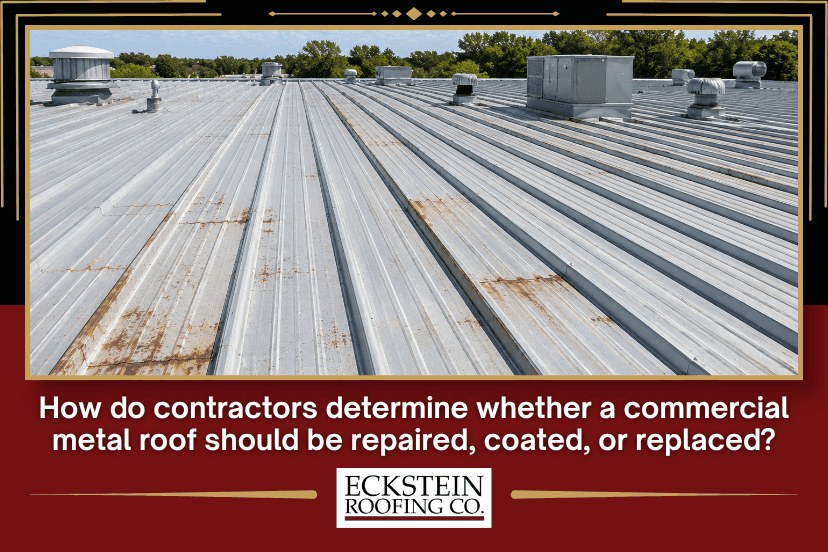
A leaking commercial metal roof does not automatically need to be replaced. A rusty commercial metal roof is not automatically a good candidate for coating either.
The decision comes down to something more important than age or the presence of a leak: what condition is the roof assembly actually in, and how widespread is the deterioration?
We have been evaluating roofing systems since 1945. We are a third generation family owned company with both residential and commercial roofing expertise, specialty metal and tile roofing capabilities, preventative commercial maintenance programs, and certified applicator status with multiple major commercial roofing manufacturers. We list Elevate, Duro-Last, Garland, GAF and Carlisle among the commercial manufacturers with which we are licensed.
That breadth of experience matters when evaluating for a commercial metal roof repair coating or replacement because we are not limited to recommending one type of solution. Our responsibility is to determine what the existing roof can realistically support.
We start with the roof that is actually there.
The Decision Starts With the Extent of the Problem
One of the first distinctions we make is whether the roof has an isolated defect or a system wide problem. A leak around one penetration is different from leaks occurring across multiple roof areas. One damaged panel is different from widespread panel corrosion. A few failed fasteners are different from thousands of fastener locations showing deterioration.
That distinction determines whether targeted commercial roof repair remains reasonable or whether we need to evaluate restoration or replacement. Our commercial repair team works with metal roofs as well as EPDM, TPO and Modified Bitumen systems. That experience allows us to approach the leak as a diagnostic problem rather than immediately assuming that the entire roof needs to go.
We evaluate the complete assembly because the visible leak is only one piece of evidence.
We Inspect the Metal Panels Themselves
The condition of the panels establishes an important baseline. We look for physical damage, oxidation, corrosion, deformation and areas where the metal has deteriorated enough that it can no longer provide a reliable substrate for repair or restoration.
This is especially important when coating is being considered.
Manufacturer requirements are explicit about substrate condition. Gaco’s specification for restoring aged metal roofing states that the metal panels must be structurally sound and securely fastened. It also states that severe oxidation can make panels unsuitable as a coating substrate and that those panels should be replaced as necessary.
That gives us a clear distinction. Surface oxidation that can be properly prepared and treated is not the same condition as severe corrosion that has compromised the panel. We do not use coating to hide that difference.
 Fasteners Can Tell Us a Great Deal About Roof Condition
 Fasteners Can Tell Us a Great Deal About Roof Condition
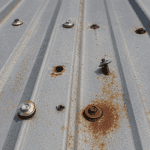
Exposed fastener metal roofing systems create another important inspection point. We check for loose and backed out fasteners, missing fasteners, deteriorated washers, corrosion and holes that have enlarged around fastener locations. Again, manufacturer restoration requirements provide useful guidance.
Gaco’s metal roof coating specification instructs contractors to inspect metal fasteners and retighten them where possible. Missing or corroded fasteners and fasteners with deteriorated neoprene grommets are to be replaced with oversize screws as part of preparation.
A handful of correctable fastener defects may support repair or restoration. Widespread fastener failure, enlarged holes and deteriorated panels can point toward a much larger problem. We determine which condition exists before recommending a path forward.
Seams, Laps, Flashings and Penetrations Matter Just as Much
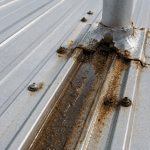
Metal roof leaks frequently require us to investigate details rather than simply looking at the middle of a panel. We inspect horizontal and vertical seams, panel laps, flashing conditions, penetrations, curbs and transitions.
These areas matter so much that coating manufacturers specifically require them to be addressed before the finish system is installed. Gaco’s Acrylic Metal Rust Primer data sheet directs installers to detail fasteners, seams, laps, flashings and penetrations before applying the finish coat. The same document requires loose rust to be removed and the surface to be completely dry and clean before coating.
That is why we do not consider coating a substitute for repair. Restoration begins by correcting defects.
If the seams are leaking, we address them. If fasteners are defective, we address them. If flashing has failed, we evaluate and correct it. If penetrations are leaking, those conditions need to be resolved. Then we determine whether the roof is an appropriate restoration substrate.
Considering coating because your metal roof has started leaking?
Have us evaluate the complete roof before committing to a coating system. We can determine whether the existing panels and substrate are suitable for restoration or whether repair or replacement is the more appropriate solution.
Can a Rusty Commercial Metal Roof Be Coated?
Sometimes, but rust by itself does not answer the question. The condition and severity of that corrosion matter.
Gaco specifies that loose rust must be removed by methods such as power washing, wire brushing or sand blasting before its Acrylic Metal Rust Primer is applied. The manufacturer also states that properly prepared ferrous substrates are necessary for maximum corrosion protection and recommends adhesion testing before application.
Its metal roof restoration specification goes further. Structurally sound panels with moderate to extensive oxidation may be cleaned or lightly abraded to remove loose surface rust and then treated with a rust inhibiting primer. Severe oxidation, however, can make a panel unsuitable for coating.
So when somebody asks us whether we can coat a rusty roof, our answer depends on what the inspection reveals. Coatable oxidation and structurally significant corrosion are not the same thing.
Can a Leaking Metal Roof Be Coated?
 Can a Leaking Metal Roof Be Coated?
Again, potentially, but we do not coat over an unresolved leak and call it restoration. Gaco’s metal roof specification specifically requires existing leaks and flashings to be repaired before application of its polyurethane coating system. That is an important point for building owners considering a commercial metal roof repair coating or replacement.
A coating system should be installed over a roof that satisfies the selected manufacturer’s substrate and preparation requirements. It is not a shortcut around investigating why water is entering the building. That investigation also needs to consider what is happening beneath the panels.
What About Wet Insulation and Trapped Moisture?
Visible panel condition does not tell us everything about the assembly. Evidence of trapped moisture or wet insulation can fundamentally change the recommendation because surface restoration does not remove moisture already within the roof assembly.
That is why our evaluation does not stop at visible leak locations. We consider the roof deck, substrate, insulation and the history of water entry as part of the larger condition assessment.
Our commercial roofing work encompasses the complete roof assembly. We identify the deck, insulation, roof membrane and surfacing as key components of commercial roof systems.
If there is reason to suspect concealed moisture, that condition needs to be investigated before we decide that covering the roof is appropriate. We will not recommend coating as a way to conceal an unresolved moisture problem.
Previous Repairs Tell Us Part of the Roof’s Story
We also want to know what has already been done. One professionally executed repair around an isolated penetration tells us something very different from a roof covered with recurring patches at seams, fasteners and transitions.
We evaluate where previous repairs were made, what they were intended to correct and whether those repairs remained effective. A repair history can help reveal whether we are dealing with a few independent defects or continuing symptoms of broader deterioration.
For buildings enrolled in a preventative program, that documentation becomes particularly useful. Our commercial roof maintenance programs include semiannual inspections, written reports, photographs of problem areas, drainage cleaning and inspections of sealants, flashing, curbs, parapet walls and other conditions.
We can therefore look at conditions over time instead of relying only on what happens to be visible on one inspection date.
When Repair Is the Right Answer
We consider targeted repair when the problem is localized and the surrounding roof remains serviceable. For example, the evaluation may identify a limited number of correctable fasteners, an isolated flashing defect, a localized damaged panel or a specific penetration problem while the remainder of the metal roof remains sound.
In those situations, replacing an otherwise serviceable roof simply because it leaked would ignore the actual condition of the system. Our goal is to correct the cause, not sell the largest scope of work.
When Coating or Restoration Makes Sense
 When Coating or Restoration Makes Sense
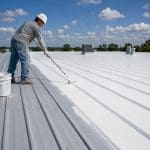
A metal roof can become a restoration candidate when the panels remain structurally sound, the roof provides an acceptable substrate, corrosion can be properly treated and existing defects can be repaired before coating.
That is consistent with manufacturer requirements. Gaco describes its polyurethane restoration specification as a remedial coating system for existing weathered metal roofs where the metal panel substrate remains sound but the finish requires rejuvenation.
Preparation is not optional. The roof needs to be clean and dry. Defective fasteners need attention. Loose rust must be removed. Necessary primers must be installed. Seams, laps, flashing and penetrations need to be properly detailed. Existing leaks must be repaired.
Only after those conditions are satisfied does coating become a credible option.
When Replacement or Retrofit Becomes the Better Direction
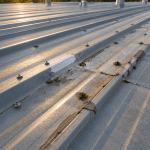 Replacement moves higher on our list when deterioration is no longer isolated. Widespread corrosion, extensively deteriorated panels, recurring failures, problematic substrates and significant moisture conditions all tell us that treating individual symptoms may no longer address the condition of the roof as a whole.Replacement is not necessarily limited to tearing every component off the building.
For qualifying metal roofs, one option we can evaluate is a Duro-Last® metal roof retrofit. Duro-Last states that its metal retrofit system can be installed directly over an existing metal deck without a tear off. Its assembly can incorporate flute fill, another insulation layer when necessary to provide a flat surface and increase R value, and a mechanically fastened membrane over the insulation.
That creates another potential path between conventional metal restoration and complete removal.
Is your metal roof beyond repeated patching?
Let us determine whether repair, restoration, a Duro-Last® metal retrofit, or replacement fits the actual condition of your building. Learn more about our commercial roofing capabilities or contact our team for an assessment.
GET MY COMMERCIAL ROOF ASSESSMENT
Repair vs. Coat vs. Replace: Our Decision Framework
When we evaluate a commercial metal roof repair for coating or replacement, the framework is straightforward.
Repair: The defects are isolated. The surrounding panels, seams, substrate and roof assembly remain serviceable, and the identified problems can be corrected locally.
Coat or restore: The metal panels remain structurally sound and provide a suitable substrate. Existing leaks and defects can be repaired first. Corrosion can be properly prepared and treated. Manufacturer preparation and adhesion requirements can be satisfied.
Replace or retrofit: Deterioration is widespread. Severe corrosion has compromised panels. Moisture or substrate problems require more extensive intervention. Previous repairs continue failing across the roof. The existing roof can no longer provide a reliable foundation for targeted repair or restoration.
The determining factor is condition and extent, not simply age.
When Do Repeated Metal Roof Repairs Stop Making Sense?
There is no responsible universal number of repairs after which every metal roof should be replaced. We look at the pattern. If one repair solves one localized problem and the remainder of the roof remains sound, repair may continue to make sense.
If new failures repeatedly appear at different seams, fasteners, panels, flashing locations and penetrations, we have to investigate whether the problem has shifted from an isolated defect to system wide deterioration. At that point, continuing to patch symptoms can obscure the larger capital planning decision.
That is where our 80 plus years in roofing becomes especially relevant. We have worked through multiple generations of roofing materials and building designs since 1945. Today our third generation family owned company works across residential roofing, commercial roofing, standing seam and specialty sheet metal systems, tile, commercial membranes and preventative maintenance.
We have options available to us. That allows our recommendation to begin with the building rather than with one product.
Why the Complete Roof Assessment Comes First
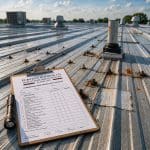 Why the Complete Roof Assessment Comes First
When deciding whether to repair, coat, or replace a commercial metal roof, the single most critical step isn’t picking out a product, it’s conducting a thorough assessment of the roof’s actual condition. It is establishing the condition of the roof.
We want to know whether deterioration is isolated or widespread. We examine panels, corrosion, seams, laps, fasteners, washers, flashing, penetrations, curbs and transitions. We investigate suspected moisture and substrate problems. We consider previous repairs and whether they solved the underlying failures.
Only then do we define the appropriate scope. That is the approach we have carried forward since 1945: understand the problem first, then recommend the roofing solution the building actually requires.
If your commercial metal roof is leaking, rusting, or requiring increasingly frequent repairs, schedule a professional condition assessment with us before choosing repair, coating or replacement. Call us at (513) 941-1511 or contact our Greater Cincinnati commercial roofing team.
GET MY COMMERCIAL ROOF CONDITION ASSESSMENT
Frequently Asked Questions
Can you coat a rusty commercial metal roof?
Yes, some rusty metal roofs can be coated when the panels remain structurally sound and the corrosion can be properly prepared. Gaco requires removal of loose rust and appropriate surface preparation. Its specifications state that severe oxidation may make panels unsuitable for coating.
Can a leaking metal roof be coated?
Potentially, but the leaks should be identified and repaired before the coating system is applied. Manufacturer specifications from Gaco specifically require existing leaks and flashing problems to be repaired before coating.
Is coating a commercial metal roof the same as repairing it?
No. Repairs correct existing defects. A restoration coating is subsequently installed over a properly prepared and suitable roof substrate according to the selected manufacturer’s requirements.
Does an old commercial metal roof automatically need replacement?
No. We base the decision on actual condition and extent of deterioration rather than age alone. An older roof with localized correctable defects presents a very different situation from a roof with widespread panel corrosion, moisture problems and recurring failures.
What metal roof conditions should be inspected before coating?
We evaluate panel integrity, corrosion, fasteners, washers, seams, laps, flashing, penetrations, curbs, transitions, previous repairs, suspected moisture and the underlying substrate. Manufacturer coating specifications also specifically require attention to fasteners, seams, laps, flashings and penetrations.
What happens if there is wet insulation beneath a metal roof?
Suspected wet insulation or trapped moisture needs to be investigated before a restoration recommendation is made. Applying a surface coating does not resolve concealed moisture already within the roof assembly.
When should a commercial metal roof be repaired instead of replaced?
Repair is generally the direction we evaluate when defects are localized and the surrounding panels, substrate and overall roof remain serviceable. Eckstein Roofing provides targeted commercial repair services for metal roofs and other major commercial roof systems.
When should repeated metal roof repairs stop?
There is no universal repair count. We become more concerned when failures repeatedly develop across different panels, seams, fasteners, flashing locations and penetrations because that pattern can indicate broader deterioration rather than an isolated defect.
Can Duro-Last® be installed over an existing commercial metal roof?
Duro-Last states that its metal retrofit roofing system can be installed directly over an existing metal roof without a tear off. The assembly can use flute fill and insulation beneath a mechanically fastened Duro-Last membrane. Whether a specific building qualifies requires an assessment of the existing roof and proposed assembly.
Who should evaluate a commercial metal roof in Cincinnati?
We recommend using a contractor with demonstrated commercial roofing and metal roofing experience. Eckstein Roofing has served Greater Cincinnati since 1945, is third generation family owned, works in both residential and commercial roofing, specializes in commercial metal systems including standing seam, maintains relationships with multiple major commercial manufacturers and offers preventative commercial maintenance programs.