

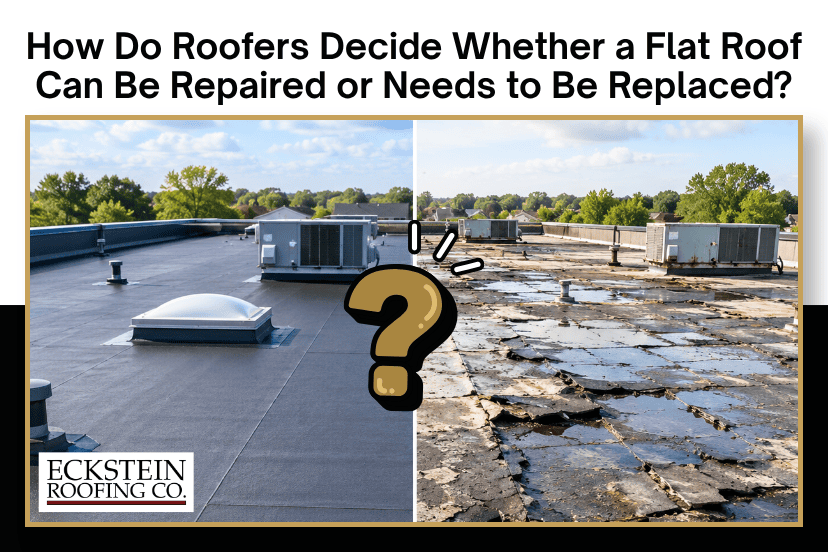
A leaking flat roof does not automatically need to be replaced. It also should not automatically be repaired.
The responsible decision comes from determining how much of the roofing assembly is actually affected. A visible puncture may represent a localized problem that can be repaired. A leak appearing in one room, however, may be connected to moisture that has traveled through insulation or other parts of the roof assembly beyond the location where water finally became visible.
That distinction is why we do not make a flat roof repair or replacement recommendation based on one leak, the age of the roof, or the appearance of the membrane alone.
We have worked on residential and commercial roofing systems in Greater Cincinnati since 1945. Our company is now under third generation family ownership, and our commercial department installs and maintains low slope roofing systems. We are licensed by commercial roofing manufacturers including Duro-Last®, Elevate, Garland, GAF, and Carlisle.
That experience has taught us to begin with the condition of the entire roof assembly.
We Start by Determining Whether the Problem Is Isolated or Systemic
One of the most important questions during an evaluation is simple:
Are we looking at one failed detail, or are we looking at a roof that is failing in multiple places?
A localized problem might involve a puncture, damaged flashing, an isolated membrane opening, or another repairable defect in a defined area. Our commercial repair department specifically handles commercial roof leaks, minor damage, major leaks, and preventative maintenance needs across major commercial roof systems.
A different picture emerges when an inspection identifies deterioration across numerous sections of the roof. Multiple open seams, widespread membrane deterioration, repeated flashing failures, recurring leaks, extensive moisture, or deterioration of the underlying substrate can change the recommendation because repairing one visible defect does not address failures occurring elsewhere. This is why counting leaks is not enough.
One leak can be connected to significant concealed moisture. Several leaks can sometimes originate from one failed detail. We need to establish the source, extent, and condition of the surrounding assembly before deciding what the roof needs.
 Roof Age Matters, but Age Does Not Make the Decision
 Roof Age Matters, but Age Does Not Make the Decision
We want to know when the roof was installed, what system is present, what work has been performed since installation, and whether maintenance records exist. What we do not do is treat age as an automatic replacement trigger.
A roof’s service history tells us considerably more when combined with its current condition. For example, a roof with an isolated repairable defect presents a different situation from a roof where contractors have repeatedly returned to repair new leaks in different locations. The second pattern raises a more important question:
Are we still repairing individual defects, or are those defects evidence of broader deterioration?
That is a condition question, not simply an age question.
We Examine the Membrane and the Details That Make the Roof Work
A flat roof inspection has to go beyond walking across the field of the membrane.
We look for observable conditions such as punctures, cracks, open seams, blistering, damaged areas, and deterioration. Then we examine the locations where the roof changes direction or interfaces with another building component.
That includes flashings, penetrations, curbs, perimeter conditions, drains, walls, and transitions. These details deserve attention because roof problems frequently develop around changes in the roof plane and other complicated details. Duro-Last documentation discussing roofing failures specifically identifies projections, curbs, drains, perimeters, and abutting walls as important areas where installation errors can occur.
A repair recommendation therefore has to address more than the spot where water is visible inside the building. It has to identify the actual pathway into the roofing assembly.
Moisture Below the Membrane Can Change the Decision
Some of the most important information during a flat roof repair or replacement evaluation cannot be established by looking at the roof surface alone. Water can enter a roofing assembly and affect insulation below the membrane.
The National Roofing Contractors Association includes visual inspections, nondestructive moisture surveys, core sampling, and leak investigation among the techniques taught for evaluating and repairing roofing systems.
These tools answer different questions.
A visual inspection identifies observable roof conditions. A moisture survey can help identify suspected areas of moisture that are not obvious at the surface. Core samples can then provide direct information about the materials within selected locations of the roof assembly.
This distinction matters because moisture survey findings should not simply be treated as absolute proof without verification. Research available through NRCA reports that nondestructive moisture detection methods still required core samples to verify findings. That gives us a much stronger decision process than guessing from the location of a ceiling stain.
Wet Insulation Is More Than a Leak Location
Once moisture is suspected beneath the membrane, we need to determine how far it extends.
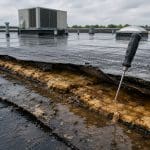 A recent 2026 technical paper available through NRCA explains that moisture within low slope roof structures can reduce insulation performance, increase the risk of mold proliferation and premature structural decay, and shorten roof service life. It also notes that moisture can result from leaks, condensation, or air leakage into the assembly. That is why finding wet insulation changes the conversation.
The question becomes whether moisture is confined to a defined repair area or distributed through a meaningful portion of the assembly. If the affected materials can be clearly identified and the surrounding assembly remains suitable, removing damaged materials and repairing the affected section may be possible.
If moisture investigation identifies extensive wet insulation across the roof, repeatedly patching the visible membrane defects does not address the full condition underneath.
If your building has a recurring leak, another surface repair may not address the underlying problem. Our commercial roof repair process starts with evaluating the roof assembly to determine whether the source of the leak is localized or part of a broader condition that requires a different solution.
GET MY COMMERCIAL ROOF REPAIR ASSESSMENT
We Also Need to Know What Is Happening at the Roof Deck
The membrane is only one part of the roof. When moisture or deterioration extends farther into the assembly, the condition of the deck or substrate becomes part of the decision.
During an evaluation, the contractor needs enough information to determine whether the materials that support the roofing system remain suitable for the work being considered. A membrane repair cannot correct an underlying substrate problem simply because the surface has been made watertight again.
This is one reason a roof can look relatively manageable from above while investigation below the surface changes the recommended scope. We are evaluating an assembly, not just its top layer.
 Drainage and Ponding Water Are Part of the Condition Assessment
We also examine how water is leaving the roof. We identify standing water, clogged drainage, foot traffic, ultraviolet exposure, wind uplift, poor installation, and inadequate maintenance among common contributors to commercial roof problems. Standing water that persists for over 48 hours is classified as a condition that demands immediate attention.
We have covered the causes of standing water separately in our guide to what causes ponding water on flat roofs.
For the repair versus replacement decision, the important point is that drainage conditions have to be considered with the rest of the evidence. Repairing a damaged membrane area without understanding a recurring water condition can leave the underlying contributor unresolved.
Previous Repairs Tell Us Something About the Roof
We pay close attention to a roof’s repair history.
A previous repair is not inherently evidence that a roof should be replaced. Properly executed localized repairs are a normal part of roof maintenance.
The pattern matters. We want to know where repairs were made, why they were necessary, whether they stopped the original problem, and whether subsequent failures appeared in the same location or somewhere else. A repair that successfully corrected one isolated defect is very different from a roof covered with repairs representing recurring problems across multiple areas.
Our maintenance programs are designed around this same principle of early intervention. We offer commercial roof maintenance programs specifically to help building owners and managers take a proactive approach before minor problems become substantially larger problems.
When Does a Targeted Flat Roof Repair Make Sense?
A targeted repair becomes a reasonable path when the investigation supports it. That means the defect can be identified, the affected area can be defined, surrounding materials remain suitable, and the proposed repair can address the source rather than merely covering the symptom. This is where knowledge of the installed roofing system matters.
For example, Duro-Last states that its thermoplastic membranes use heat welded seams, and its current roofing systems include custom fabricated accessories for penetrations and transitions. Duro-Last can complete up to 85 percent of membrane seams in a factory controlled environment before custom fabricated deck sheets reach the roof.
Duro-Last also reports that a traditional 50,000 square foot roll goods layout can require more than 7,500 linear feet of rooftop seaming, compared with fewer than 1,300 linear feet for its custom fabricated system example. Those are manufacturer specific characteristics, not universal claims about every flat roof. Our job is to understand what system is actually installed and determine which repair or replacement procedures apply to that roof.
If an assessment shows that replacement is the appropriate path, we can also evaluate whether a Duro-Last commercial roofing system fits the building rather than forcing one product onto every project.
When We Recommend Flat Roof Replacement Instead of Repair
 When We Recommend Flat Roof Replacement Instead of Repair
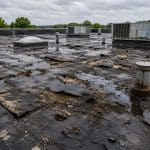
Replacement becomes increasingly difficult to avoid when the evidence stops pointing toward isolated failures and starts pointing toward a compromised roofing assembly. That may include widespread membrane deterioration, extensive moisture within the insulation, recurring leaks in multiple areas, deterioration of the deck or substrate, repeated unsuccessful repairs, or numerous failing details throughout the roof.
No single item on that list automatically creates a universal replacement rule. The recommendation comes from the combination and extent of the conditions found.
If replacement becomes necessary, building owners often immediately worry about what that means for disrupting their daily operations. We address that separately in our blog article Can You Replace a Commercial Roof Without Interrupting Operations?.
Why Eckstein Roofing Looks at the Complete Roof
We have been roofing since 1945, and today we remain a third generation family owned company serving both residential and commercial customers. Our experience includes low slope commercial roofing, asphalt shingle roofing, standing seam metal, tile, specialty sheet metal work, repairs, and preventative commercial maintenance. Eckstein Roofing is also licensed by multiple major commercial roofing manufacturers.
That breadth matters during diagnosis. It allows us to approach a roof with a simple objective: establish what condition actually exists before recommending the scope of work.
The best answer is not automatically the smallest repair. It is not automatically a new roof either. It is the scope supported by the evidence.
When evaluating whether to repair or replace a flat roof, begin by scheduling a comprehensive inspection to identify if the damage is localized or widespread, and to verify whether moisture has penetrated deeper into the assembly.
Ready to determine what your roof actually needs? Have us evaluate the condition before deciding between another repair and replacement. Call (513) 941-1511 or request a commercial roofing inspection.
GET MY COMMERCIAL ROOF INSPECTION
Common Questions: Flat Roof Repair vs. Replacement
Can a leaking flat roof be repaired instead of replaced?
Yes, when investigation shows that the problem is localized and the surrounding roofing assembly remains suitable for repair. The leak source, membrane condition, insulation, flashing, penetrations, drainage, and substrate should be considered before that conclusion is made.
Does one leak mean my flat roof needs replacement?
No. One visible leak does not establish the extent of roof deterioration. Contractors need to locate the source and determine whether moisture or damage has spread beyond the visible problem.
How do roofers find moisture underneath a flat roof?
Visual inspection can be supplemented with nondestructive moisture surveys and core sampling. NRCA specifically includes these methods in professional roof inspection and repair training. Research available through NRCA also emphasizes verifying moisture survey findings with roof samples.
Does wet insulation mean the entire roof must be replaced?
Not automatically. The extent and location of the moisture must first be established. Localized affected materials present a different condition from moisture distributed through large portions of the roof assembly.
Is roof age enough to decide whether a flat roof should be replaced?
No. Age and service history are useful information, but the recommendation should also consider membrane condition, moisture, insulation, deck condition, flashing, drainage, previous repairs, and the distribution of failures.
Can repeated flat roof repairs eventually point toward replacement?
Yes. The important issue is the pattern behind those repairs. Recurring leaks in multiple locations, widespread deterioration, extensive moisture, or underlying substrate problems provide fundamentally different evidence from one isolated defect.
What should I do if my commercial flat roof keeps leaking?
Document where and when leaks appear, preserve previous repair and maintenance records, and have the roof evaluated rather than continuing to treat each interior symptom independently. Eckstein Roofing provides commercial leak repair, roof assessment, and preventative maintenance services throughout the Cincinnati area.